Showing posts with label Transantarctic Mountains. Show all posts

Monday, January 31, 2011

30 January--Castle Rock

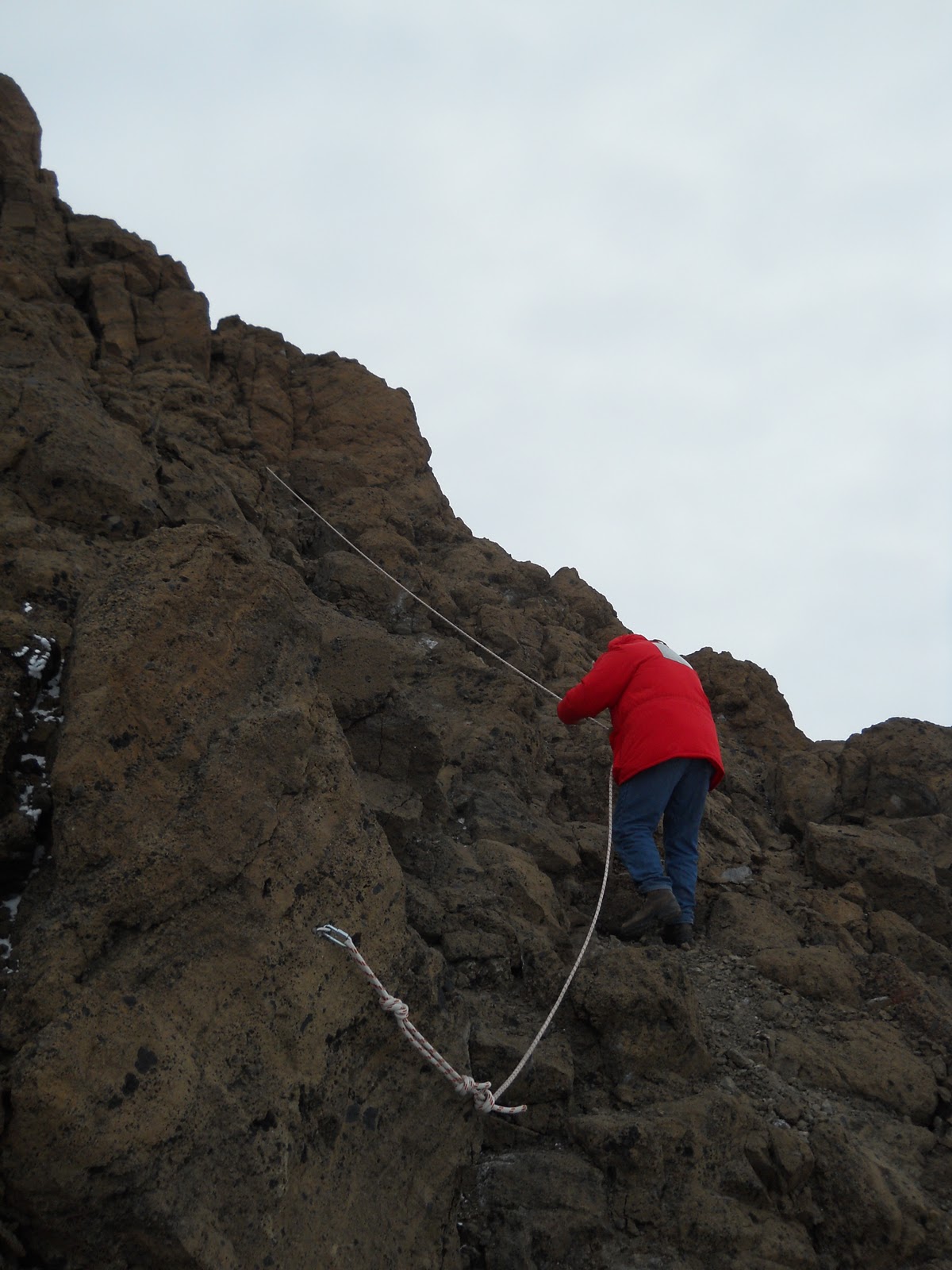
This was the second of my 2 consecutive days off and a welcome break it was.  I finally hiked the Castle Rock Trail and ascended Castle Rock itself.  Jerry Perkins and I left soon after dinner and were back by Mid-Rats.  To hike outside of town any distance, you have to file a plan with the Fire House, have at least 2 people and a radio, have attended the Outdoor Safety lecture, and must check in afterwards.  The trail begins outside of town, up by Arrival Heights, and goes for several miles out to Castle Rock.  Most of it is over hard-packed snow and because of visibility issues, there are flags on bamboo wands every 30 feet or so.  For variety, you can link into a trail that goes back via Scott Base.


 Along the way there are two survival huts called Apples, stocked with sleeping bags and pads; a stove, fuel, and pot; and emergency food.  The second one has a telephone back to base.  I called the Shuttles Office to see if it worked, but was thinking how cool it would be to call Flagstaff.


The Castle is an old volcanic neck made up of basalt and a basalt conglomerate from what must have been a later eruption.  There are lots and lots of basalt pieces included in the reddish brown matrix.  In places there are fixed ropes up the steeper sections of the route.


It's been known as Castle Rock since Robert Falcon Scott's first expedition.  Early in that expedition, a party came up into this area and were hit by a blizzard.  The group had done no prior practice or training--that was pretty standard practice for Scott--and were unable to set up their tent.  Some people tried to make their way back to the nearby Discovery Bay and Hut Point.  One man, George Vince, fell off a steep slope, slid into the water, and drowned.  That's the origin of the cross on the low hill above the hut at Hut Point.  Interestingly, another man knew to burrow a bit into a snow bank and let the storm cover him.  He slept out the storm snugly and walked back to Hut Point the next day, none the worse for wear.


Ice crystals growing inside my water bottle.

The open water meets the sea ice.  A few icebergs, calved off from the Erebus Glacier were visible.


Glaciers flowing out of the Royal Society Range across McMurdo Sound


A Skua doing what it does best.

Tri-walls of food waste awaiting retrograde to Port Heuneme for composting.  MREs for Skuas.  Each is about 1 cubic meter.  (Tri-walls are triple thickness cardboard boxes--just the thing for home storage.)

Tuesday, January 18, 2011

18 January--Emperors Rule! The Ships Arrive!

For the last few days there have been a group of 3 Emperor penguins hanging out at Half Way House on the road out to Pegasus Field.  I'm told it's common for molting penguins to stay in one place during the molting season.  I was able to get within 5 or 6 meters of them without causing them any anxiety, but I think if I had had more time and could have gone down on my knees or--better yet--slithered along the snow, I could have gotten within 2 or 3 meters. 


There are stories going around about how to get close to penguins by arousing their natural curiosity, which they are are full of.  One reputed way is to waddle about on your knees.  Depending on your height, this might just put you at about eye level for an Emperor penguin.  A second way is to slither along on your belly the way Adelies and perhaps Emperors do.  Another way is to wave your arms like they flap their stubby little wings.  There is one story of a person who was able to get so close to an unidentified penguin that he reached his hand out to touch the penguin's wing.  The penguin swatted it away so forcefully that it broke his hand.  Don't mess with a penguin!

The two expected ships also came in a few days ago.  The Swedish icebreaker/research vessel Oden arrived first, forcing a way through the thicker than expected sea ice.  The Nathaniel B. Palmer, a NSF chartered ship, was not far behind  The Oden continues to keep the way open and the Palmer is docked at the floating ice pier.  Many of the scientists aboard both vessels flew out early this morning for Christchurch and are being replaced by others who flew in yesterday.  The Oden will be around until after the tanker and the freighter arrive in two weeks or so.  The Palmer will be leaving tomorrow at some time for a 2 week research trip, then return to McMurdo for refueling, and go immediately out for another two weeks.


The Oden rounding Hut Point and coming in to the floating ice pier.

The Oden further out in the Sound.


The Oden.

The most pleasant thing about getting the ships here was getting to see my good friend George Aukon.  He's been working on the ships for the last 3 years, but has worked for Raytheon now for 6 or 7 years as an electronics technician. George and I met down in Costa Rica in 1991 at a Project R.A.F.T. ("Russians and Americans for Teamwork") international whitewater competition.  We helped him and his family move to Flagstaff and they all became American citizens.  One of the years down here, the American icebreaker apparently broke a prop and couldn't continue.  A Russian icebreaker was hurriedly contracted to clear the way.  George was lateraled over to be the Russian and English speaking liaison aboard the ship.  On board were a number of people that he knew from his Arctic service in the Soviet navy. 


The Nathaniel B. Palmer docked at the ice pier, McMurdo station.


Here are a few more miscellaneous photos that I did not take, but wish I had:


A launch from the Long Duration Balloon facility on the way to Pegasus Field.  An aerial jelly fish?


Sunday, November 07, 2010

4 November--Hhmmmm...

Found out today that I get to go to Happy Camper ("Snowcraft") training tomorrow and the next day.  That should be very interesting and something I've been hoping for.  More on that on Sunday after I get back.


They've installed an observation tube in the ice off Hut Point.  It's supposed to be basically a narrow tube down through the ice with a plexiglass observation tube at the bottom, reached by narrow rebar steps.  Narrow enough that you can't wear Big Red down.  People have talked about seeing seals and fish swimming by.  It's shallow enough that you can see the bottom and all the way to shore.  Apparently, you can see best when the lid is closed, but that's a red flag for claustrophobia.  Key is checked out from the Rec Department.

Wednesday, November 03, 2010

3 November--No Man is an Island?

Well, maybe no man is an island, but it's beginning to feel a bit like a very small island here, rather than a continent.  Yeah, I know that we're on Ross Island and technically it's an island off the coast of the continent.  It's sort of reminiscent of our house exchange to Tahiti.  After being wined and dined by the French couple for two days, we took a drive around the island by ourselves on our first full day there alone.  We were done by mid afternoon and we looked at one another and asked,"What do we do for the next 3 weeks?"  I feel very lucky to be driving out several miles in one direction and 2 miles in the other, as well as up to the hill that overlooks town.  But that still constitutes a very small island, in the bigger picture of things.  A very small island indeed.


Twin Otter
 Following the severe weather of the last 2 days, the open water is now 11 miles from the Ice Runway.  Apparently that's a rather rapid recession of the ice.  It might force an earlier move to Pegasus Airfield.  That would entail a 45 or 50 minute drive each way, rather than the 6 or 7 minute drive now.  On the other hand, it would mean open water with whales, seals, and penguins.


There are some interesting forms emerging as the snow starts to melt and the wind dusts it with volcanic dust.  Beauty covered with dirt. Dirt: part of nature's artwork.  Ephemeral ice needles.