Monday, February 07, 2011

7 February--Almost in a Condition 1


The other evening began so startlingly beautifully and by the early morning had gone through Condition 1 and back to Condition 3, the normal situation.  I was driving back from Pegasus Field and the first indication I had that something was coming was a bank of low-lying clouds under a line of higher clouds.  The wind picked up and the low-lying clouds were skimming the surface with drifting snow blowing in front of them.  The snow appeared first like tendrils of some sort of white vegetable matter, hugging the snow and ice surface blowing across the ice road and searching out its preferred route.  At first you could see over the ground clinging tentacles to the nearby mountains, but it got thicker and the topography became obscured.  Soon you could only see 10, then 7 and finally I could only make out 4 or 5.

The roads have flags every 50 feet or less to help with navigation in conditions like this.  Normally you can see at least 20 or so, more if you were to stop driving.  When visibility goes down to 3 flags or less, the rule is to stop where you are, call in your position,  and remain where you are until either the situation clears and MAC-Ops downgrades the condition or Search and Rescue comes out to retrieve you. This is precisely the reason we only go out on the Ice Shelf with a full tank of gas and our full ECW bag.
I was able to continue on and get off the Ice Shelf, but a later shuttle driver was out there and a Condition 1 was called and he and his passengers had to hole up in the Galley out at the airfield.   Luckily, things cleared within an hour.  This was only the second Condition 1 we've had this season, something returnees say happens much more commonly.


"Who's the joker who put this on my head while I slept?  Is there someone with opposable thumbs who can get this off ?"


This is Building 155, where I live.  It's a combination dorm, kitchen, dining hall, offices, barber shop, laundry, library, weight room, television and radio studio, ATMs, and computer commons.  During the summer, it's where all the newbies have to live; during the winter, it's the high value real estate.  Overwintering returnees with lots of points fight to live here so they don't have to bundle up to get to meals.


Snout of a glacier near the CTAM camp (not one of my pics).


Thursday, February 03, 2011

3 February--Penguins Most Artful

I volunteered again this morning to run a tour out to the group of 14 molting Emperor penguins near Half Way House on the road to Pegasus.  These follow a very long 12-hour shift but it's really gratifying to see how much the people enjoy them.  Some people are desk-bound in McMurdo and seldom get out, leading to the question: why bother coming down here?  Economic necessity?  Wanted by the law?  Perversity?  It was very, very cold out there and some people retreated early to the heated van.  It's not entirely unselfish on my part; I thoroughly enjoy being out there.  it's one of the major reasons i came down here.


Advanced molting.  It looked like you could have grabbed fistfuls of feathers.  One website said it took an average of 34 days for an Emperor to molt.


Penguins seem to really fascinate people.  Kneeling, laying down or otherwise getting low seem to set them more at ease.


There are some very talented people down here and it shows in their art: several outdoor metal sculptures; paintings and ceramics displayed in the library; crafts displayed and for sale.  Penguins and other birds are a common theme, perhaps because there is so little life on or above the ice.  (Below the sea ice and the ice shelf life, it's entirely different.  The Ross Sea is wonderfully rich; the algae and bacteria support an unimaginable richness of krill that feed fish, seals, whales, and other life.)


This is titled "Skua Wants A Cracker."


"Snow Petrel"


Walking house of Baba Yaga, Russian witch of fairy tales.


One year's worth of food waste for retrograde to Port Hueneme and composting.  For scale, each of these Tri-Walls is about one meter on a side.  Any food that leaves the kitchen to go to the serving line and is not eaten must be discarded.  Leftovers can only be made from food that stayed in the kitchen


Monday, January 31, 2011

30 January--Castle Rock

This was the second of my 2 consecutive days off and a welcome break it was.  I finally hiked the Castle Rock Trail and ascended Castle Rock itself.  Jerry Perkins and I left soon after dinner and were back by Mid-Rats.  To hike outside of town any distance, you have to file a plan with the Fire House, have at least 2 people and a radio, have attended the Outdoor Safety lecture, and must check in afterwards.  The trail begins outside of town, up by Arrival Heights, and goes for several miles out to Castle Rock.  Most of it is over hard-packed snow and because of visibility issues, there are flags on bamboo wands every 30 feet or so.  For variety, you can link into a trail that goes back via Scott Base.


 Along the way there are two survival huts called Apples, stocked with sleeping bags and pads; a stove, fuel, and pot; and emergency food.  The second one has a telephone back to base.  I called the Shuttles Office to see if it worked, but was thinking how cool it would be to call Flagstaff.


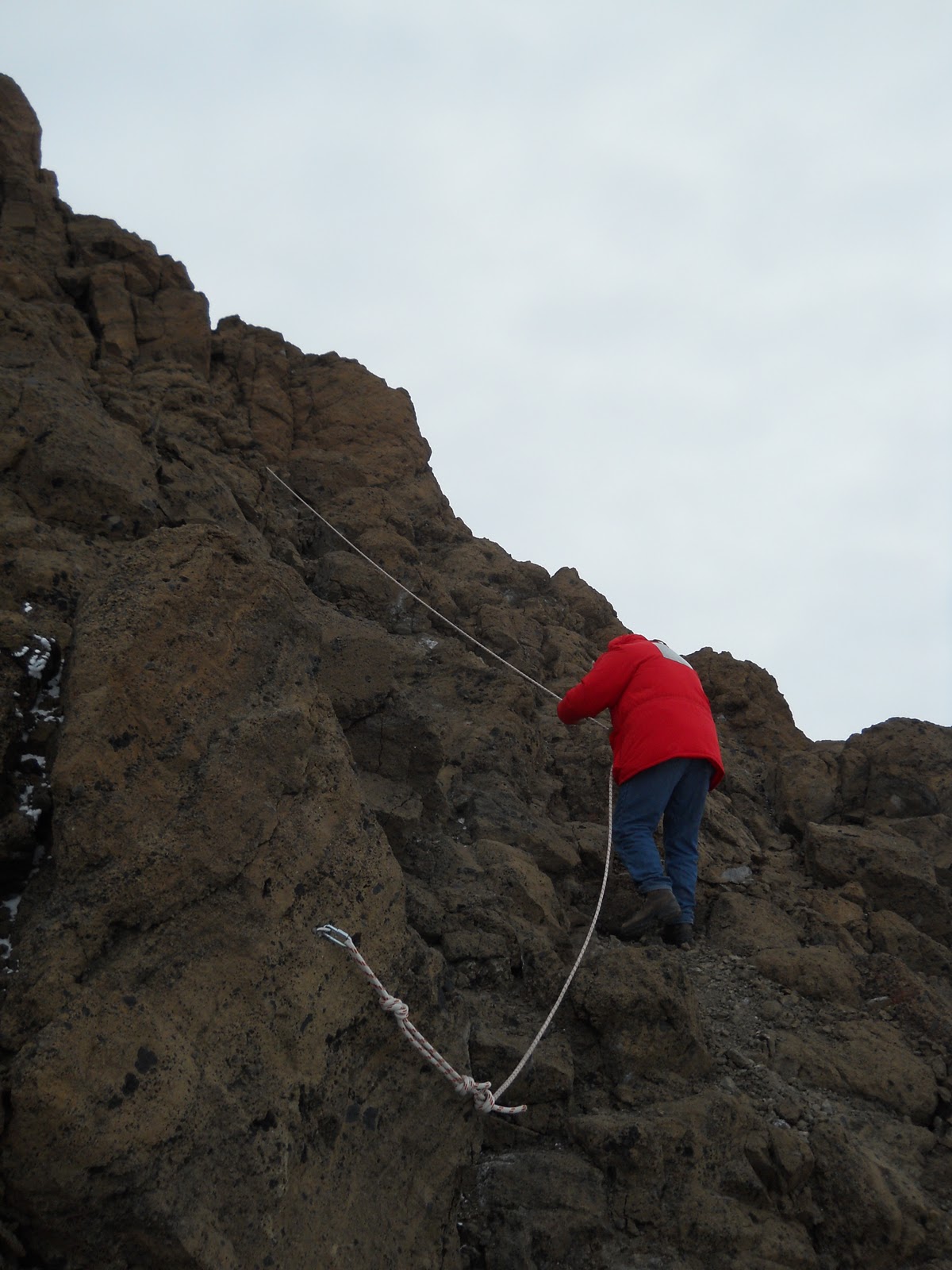
The Castle is an old volcanic neck made up of basalt and a basalt conglomerate from what must have been a later eruption.  There are lots and lots of basalt pieces included in the reddish brown matrix.  In places there are fixed ropes up the steeper sections of the route.


It's been known as Castle Rock since Robert Falcon Scott's first expedition.  Early in that expedition, a party came up into this area and were hit by a blizzard.  The group had done no prior practice or training--that was pretty standard practice for Scott--and were unable to set up their tent.  Some people tried to make their way back to the nearby Discovery Bay and Hut Point.  One man, George Vince, fell off a steep slope, slid into the water, and drowned.  That's the origin of the cross on the low hill above the hut at Hut Point.  Interestingly, another man knew to burrow a bit into a snow bank and let the storm cover him.  He slept out the storm snugly and walked back to Hut Point the next day, none the worse for wear.


Ice crystals growing inside my water bottle.

The open water meets the sea ice.  A few icebergs, calved off from the Erebus Glacier were visible.


Glaciers flowing out of the Royal Society Range across McMurdo Sound


A Skua doing what it does best.

Tri-walls of food waste awaiting retrograde to Port Heuneme for composting.  MREs for Skuas.  Each is about 1 cubic meter.  (Tri-walls are triple thickness cardboard boxes--just the thing for home storage.)

Saturday, January 29, 2011

29 January--One Month to Go

The break in posting here may be the best evidence of the exhaustion setting in.  Long hours of generally routine work, sleep at what used to be a foreign hour, and not as many peak experiences; that about sums it up.  I have just less than a month to go on the Ice.  I'm due to fly out on a Boeing 757 on February 23rd, weather willing.  As the season proceeds, the weather gets chancier.  Iffiier.  Dicier.  Kathi is to fly into Cheech on March 1st, giving us a cushion in case the weather proves to be antarctic.

Almost a week ago I was driving an Airfield Shuttle from McMurdo to Pegasus when I came across 3 Emperors standing in the middle of the road.  The middle of the road!  And they were none too eager to move.  It actually gave me a wonderful excuse to stop and photograph from the van window.  In a few minutes they moved a bit out of the lane and towards the adjacent one where the Galley truck was coming up.  (The Galley truck carries out food to the Galley at Pegasus for those folks who are working out there during meal times.)  The Emperors waddled up fairly close to the Galley workers who had spilled out of the truck to take photos.  When I could no longer keep my passengers waiting, off I drive.


My favorite photo.

Note the tire marks.


The weather whipsaws back and forth and there's no way yet to know from day to day what it will be or how to dress.  Weather forecasts?  Nah, the best they seem to be able to do is to tell you what it is outside at the moment.  "You don't need a weather man to know which way the wind blows."  But it has presented some interesting situations. 

Last night I was working as airfield taxi, which means I was there all night waiting for LC-130s to come in so that I could transport the flight crews from their planes to the airfield shuttle, who would take them in the almost hour-long trip back to McMurdo.  Only the taxi can come on the apron and approach the plane, after clearance from MC1.  It's usually a great place to get a lot of reading done for the 7 hours out there.  While out retrieving a flight crew back from the South Pole, a tendril of fog came in and visibility went to near zero in minutes.  If I didn't have a good sense of direction, it would have been impossible to move and get back to the  Galley area.  After it had mostly cleared, Mac-Ops called a Condition 2 for the area, restricting movement.


Makes me think of the closing scene in "Casablanca."


I'm left wondering how they can take off and land in this sort of fog.  And this was the 146th flight that they've done this year to the Pole, their busiest destination.

After work I volunteered to take a group of people half way back on the Pegasus Road to Half Way House to see the group of molting Emperor penguins.  An exceptionally nice group of people, including 2 Chinese scientists, Zhibin Yu and Weitao Hunag, that I've become friends with.  The temperature difference between McMurdo and the ice shelf was dramatically extreme.  People who had asked me about having to take their ECW gear were glad they had it.  Some retreated to the van fairly quickly.  But the experience was wonderful.  Consider that this is only a few hours after the pea soup fog at Pegasus.  The views were startlingly clear, diamond clarity.

When their feathers molt, they need to avoid swimming until the new feathers come and get coated with a waterproof layer.  That allows the feathers to insulate them when they go diving.  For Emperors the process can take 34 days.  Not being able to swim means not being able to eat and they rely on their blubber reserves.  They seem to like this particular spot because Fuels has built a large berm to hold an intermediate pump, which the penguins use to get out of the wind with their diminished insulation.


Emperors with Ob Hill in the left background.  McMurdo is on the far side of that ridge.


Emperors with Mt. Erebus in the background.  Almost no steaming from the crater.


When they spread their wings and stretch out their necks, you almost expect them to burst into spontaneous song and dance.  An Antarctic Bollywood.  Silly.  I know.
Weddells basking.


Weddell surfacing in an open water break.