Showing posts with label underside of annual sea ice. Show all posts

Wednesday, December 01, 2010

1 December--Let the Holiday Madness Begin


An LC-130 taking off from the Ice Ski-way.


The Ice Runway (or  Ski-way) is built on annual sea ice. The temperatures are getting up to to the point where its strength is diminishing.  On December 3rd the Ice Runway will be closed and all operations will move to Pegasus Field.  The entire Ice Runway Town will be disassembled; Pegasus Town is currently being built.  The advantage of Pegasus is that it is on the Ross Ice Shelf, a glacier floating on the Ross Sea.  In places the ice shelf is hundreds of feet thick.  The disadvantage is that a trip from McMurdo to Pegasus Field can take an hour.  That's why it is worth all the effort to keep the Ice Runway operating as long as possible and not just permanently using Pegasus. 

You just can't keep those kids down!


Over the Thanksgiving weekend I hiked over to Scott Base and returned via the backside of Ob Hill.  Among other things, that is where the Americans go snowboarding.  The Kiwis have their own slope and it's rumored to be much better.
I think this is what is called a ventifact, a piece of rock shaped by the wind.  It is a piece of sandstone found on a slope that is otherwise almost entirely basaltic.  That in itself is a bit odd.  The wind doesn't seem to have the same effect on the basalt, perhaps due to hardness, but it's created a form of desert pavement by blowing away the fine materials.

People had told me that I wouldn't believe what a special meal food services would prepare for Thanksgiving.  They were right!  But it was nothing short of astonishing.  People were all dressed up for the occasion, some in outfits like you'd expect back in the states for a big family get-together and others in McMurdo chic.  Like a dress and basic issue, blue Asics Tiger FDX boots (these are issued for people going to the really cold places like the Pole or people going to be out all day long unprotected.)  There was a definite style and flair.  The line began outside the galley at least 30 minutes before dinner and there were 3 scheduled sittings at 2 hour intervals.

There were both turkey rolls and 2 carvers slicing off birds recognizable as turkeys.  Several different iterations of mashed potatoes and sweet potatoes.  Gravy, of course.  An apple and sausage stuffing that was phenomenal. Fresh roasted asparagus.  Several other vegetables.  Rolls and fresh breads.  The vegetarians were not forgotten, either.  The dessert table rotated during the evening but I'd guess that there were at least a dozen different desserts, including the traditional pumpkin and apples pies, torts, cakes, fresh strawberries and fresh strawberries dipped in chocolate.  There was a dark chocolate layer cake with cherries between the layers, topped with a dark chocolate icing/glaze.  That one was so good that I had to go back just to convince myself it was as good as my first impressions said it was.  And it was.  Most people had wine and it flowed freely (the galley is normally dry with the exception of Saturday nights.).  sorry, Kathi--no tomato aspic.  No Mama Stamburg's relish, either.  The cooks were brought out to the galley by a long and extended standing ovation.  They certainly deserved it.  We were finally scooted out after 1.5 hours so that they could strip the tables of the linens and do the whole thing all over again for the next sitting.

The only downside: a person from the kitchen was discovered drinking on the job and immediately fired.  Flown out two days later on the first flight north.  As they say, it's a harsh continent.

Imagine a holiday dedicated to glorifying gluttony!


I went back for a sixth and seventh visit to the Ob Tube.  Good thing too since they removed it on the 30th.  The quality of the sea ice was deteriorating on the approach and it was only a matter of time.  There were white, 6-inch jelly fish propelling their way past the window.  Lots of krill.  We heard the calls of seals but another friend actually saw a seal pass by the tube 5 feet away.  When we surfaced, a seal was hauled out and completely oblivious to us.  They generate enough heat laying there that they melt a shallow indentation itno the ice.  Even with the tube removed, this will be a great place to come back to to watch the seals.


Weddell seal.  Blissfully unaware of the bloody seal genocide of 100 years ago.  Rest sweetly.

Scott Base


Only Flagstaff is missing.

Scott Base holds a certain fascination for the Americans here.  They take a shuttle over on Thursday evening for American Night at their bar.  They take a shuttle over on the half hour on Sundays to visit their shop.  They tramp over every day to shop some more during open hours.  Is shopping genetic?   A drive for the less familiar and more exotic?  To fill an empty niche in our souls?

The entire base is painted a single color.  It's much more modern than McMurdo and the various parts are mostly all connected by enclosed hallways, so there's no need to bundle up and scurry between buildings.  I suspect the reason is that it was either much more recently established than McMurdo or it recently replaced something much older.  McMurdo has been stitched together piece by piece over the years with little central plan.  Thus the Mine Shaft Modern Eclectic style at McMurdo.


As the open water of the Southern Ocean gets closer and closer, there is more tidal action on the sea ice and open pools are created along the shore in places.  This one gets used by the Weddells from time to time.


Holiday Greetings!


Tuesday, November 23, 2010

23 November--Ob Hill Loop


A luxurious day off and I was able to sleep in until 0630, something I haven't done in ages!  Hit the gym and after lunch go on a hike I hadn't known about around the base of Ob Hill.  It starts down below the Heliport and goes around the hill until it hits the road to Scott Base in Gas Pass.  Once you get around the hill a bit, the sounds and sights of town fall away.  Most of the trail is fairly flat and passes across volcanic cinder slopes with a few volcanic bombs.  In a few places it gets steep and snow covered, but the trail volunteers have done a wonderful job clearing away the worst.  There are great views across the sound to the Royal Society Range and. later on, to Scott Base and the Ross Ice Shelf.  I hadn't seen the boundary between the ice shelf and the annual sea ice before, but it's pretty distinct.  The contrast between the hike here and yesterday's walk around the pressure ridges couldn't be greater.


Passing by the Heliport.


That long and winding road...

Weddell seals sunning themselves in the warm sun.

Mt. Terror, Scott Base, and the Ross Ice Shelf.

Hiking Ob Hill reminds me a lot of hikes in the Flagstaff area.


Volcanic bomb.  Note the spiraling, ropey structure from end to end.


Cheaper by the dozen.
 Addendum: after posting all of the  above, I went on a short hike at 2100 hours to the Observation Tube.  The krill are getting bigger and I saw 2 ethereal, white jelly fish.  There was a weird call of a seal from a distance, nothing like the sounds you might associate with a Sea World performance.  It was almost like those recordings of whales you might remember from the 1970s.


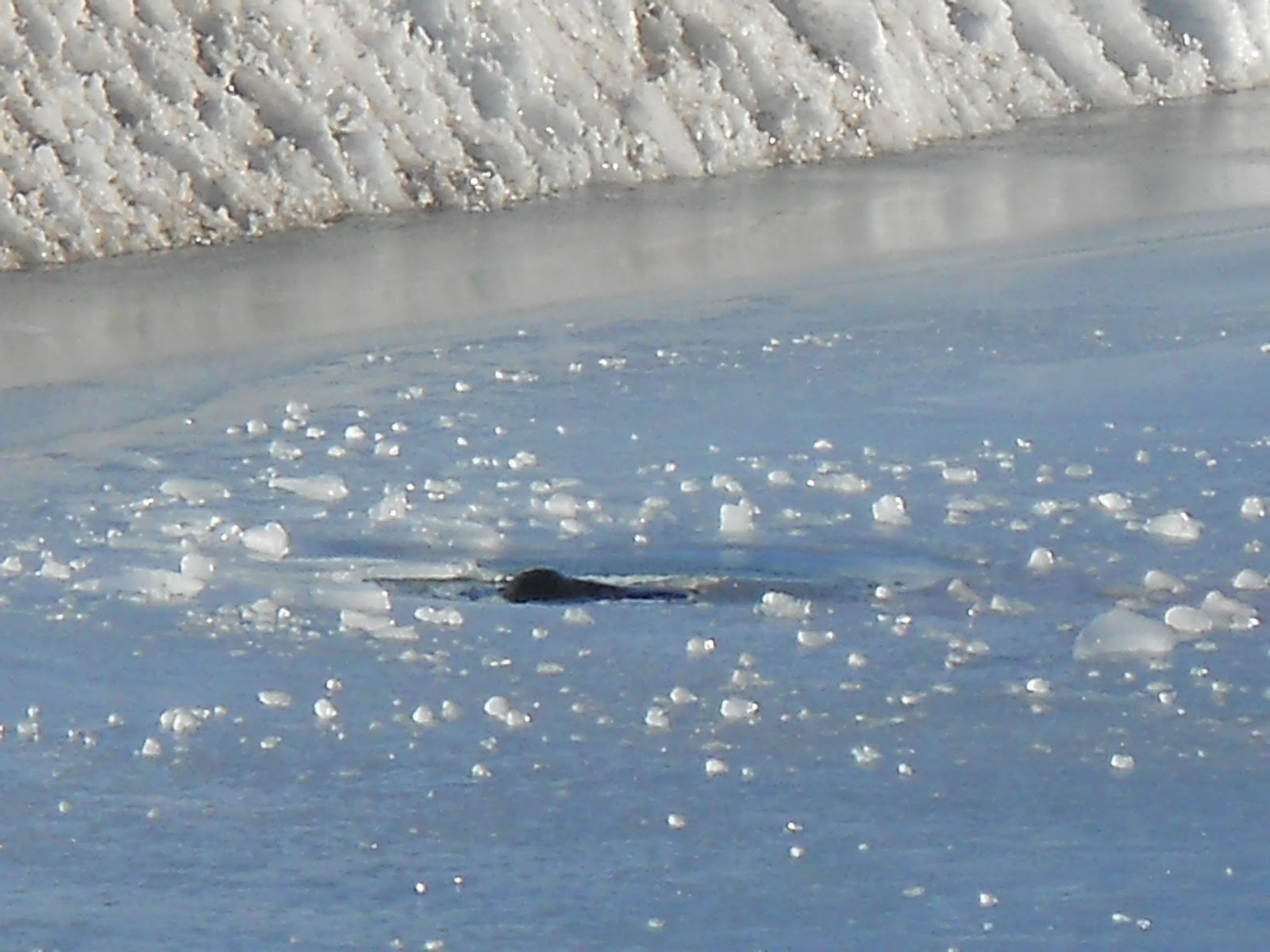
When we came up from the tube and were going back across the ice to shore, we spotted broken ice on the surface of the partially refrozen surface of a melt water pool.  Waiting quietly we were able to see a Weddell seal come to the surface and blow off CO2 noisily.  He came back at about 5 or 6 minute intervals.


Learned that this is the first year that the Observation Tube has been here.  Previously it was at a penguin research site elsewhere in the Ross Sea.

Thursday, November 18, 2010

18 November--Meet the Doc(s)


Meet Doctor Harry Owens, head doctor of the McMurdo General Hospital.  My biggest disappointment is that you'll never be able to meet Harry.  He's absolutely inspirational!  Harry has been coming down here for 4 of the last 5 seasons, if I have this right.  But as I talk to him in the clinic (for my back) or at a table in the galley, more and more things just keep spilling out.  For instance, he once had a practice in Alaska for a while, but much of his career has been in very remote and under-served areas, like little Inuit bush villages in northern Alaska or on the Aleutian Peninsula.  Some of these have been in public health clinic settings and many others as a volunteer, most likely with expenses covered.  He's also spent a good long time as a doctor on a boat on the Amazon River in Brazil and most recently in southern Sudan.  Working on the Amazon, he learned Portuguese and used that later working in Guinea-Bissau and Mozambique, other parts of the Portuguese speaking world.  I can't even remember the list of all the countries he's volunteered in as doctor, but believe me, it's long.  A number of people do this sort of thing in their retirement after they have worked through their careers; Harry has been doing this for much of his career. 

As an aside, I learned later--after this was originally posted--that he grew up on a sheep ranch 25 miles northeast of Flagstaff and still has relatives living in town.

One of his secrets has been to keep his wants and needs low, though he apparently he has a small forest cabin in the Willamette Valley in Oregon to retreat to between medical tours. You have probably never met anyone as cheerful, upbeat, and eternally optimistic as Dr. Harry.  He's the sort of person I can vaguely remember reading about at my aunt's house in the "My Most Unforgettable Character" section in her Reader's Digest magazine.  Much better would be a New Yorker profile of him by one of my favorite non-fiction writers, John McPhee.  Does anyone out there know of a budding writer who could write about this marvel for the larger world?  I'm serious!  Let me know and I can get his contact information.

Some of you have asked about how we live.  There are a number of dorms here, but most FNGs start off at Building 155.  It's conveniently central to everything, including the galley, computer kiosk, barber shop, the store, ATM (yes, an ATM, who would have figured that?) and recreation office.  Some of the rooms along the outside walls have windows, which is problematical during the 4 months of 24 hour a day light.  Keeping the room dark enough to sleep can be a challenge.  During the winter I suspect these rooms could be colder.  Many more of the rooms have no window, which can be a bit creepy at first.  Mine is one of those. 

My corner of the room.
   We each get a wardrobe, a nightstand and part of a bunk-bed.  We've chosen to set them up as singles and I've got my raised high enough that the nightstand fits partly under the bed to save room and giving me more storage under the bed.  Two of the roommates have hung blankets around their corners, giving themselves more privacy, but making their corner even more dungeon-like to my tastes.


I think this is the famous milvan (shipping container) that was blown over by the wind at some point recently.  Look closely and you'll see 3 concrete blocks attached to it; there are several more on the other side.  It took the milvan and the blocks and rolled them all over a few times.  If I'm right, a cubic yard of concrete is about a ton.


This is located up on a hill called T-Site and I get to drive up here a few times a week.  The view is stunning.  There's an exciting NASA project going on up there that will have very real and spectacular results for all of us over the next few years.  Currently, all the worldwide satellite data that the the Big Guys use is at least 2 hours old when they get it to number crunch and it only covers about two thirds of the land areas of the globe.  This project will raise the percentage to 100% of the land and drop the time lag to 23 minutes.  This should have big implications for tornado forecasts in the Midwest and flooding predictions in low-lying places like Bangladesh.  (Maybe even New Orleans?  Nah, that gets into issues of race andclass.)  It relies on some new satellites going up and these haven't been budgeted yet so far, but let's hope that that happens.

Finally, I haven't been able to keep myself away from the Ob Tube and its ethereal lighting.  Here are a few more of that.


As wonderful as seeing all this for the 4th (!) time was, it was perhaps even neater seeing it through the eyes of someone else, someone new to it.  The trip was spontaneous.  Another shuttle driver came over at dinner and I was describing how fantastic the views were under the ice.  We decided to go back and see it again.  A gentleman sitting near us asked if he could go along and we invited him, too.  It turned out that he was a grantee down here for 3 weeks from the University of Alabama at Birmingham.  Dr. Asim Bej, here 30 years from his native Kolkata, has as his specialty the DNA of the algae and bacteria that grow under the ice.  Divers bring him the samples from under the ice or get samples from under the frozen lakes of the Dry Valleys, but he had actually never seen these in the wild.  He went ecstatic over seeing his field of study in its actual setting, in its context.  It was such a pleasure to have helped him get to see this.  Very gratifying!

To close, in an adjoining room someone is practicing "Over the Rainbow" and "Greensleeves" on the tuba of all instruments--over and over again and not all that well.  A real experience.  Bless them, they deserve to get good.

Sunday, November 14, 2010

14 November--Like A New Beginning

The second day of Happy Camper school I pulled my back out and spent the next few days going to physical therapy, laying flat on my back in bed, and generally feeling miserable and hunched over.  In addition to certain stretches, the doctor and physical therapist both recommended walking as a good activity.  The next few days I went to work but was relegated to working Dispatch for 3 hour spells.  It was still too uncomfortable to sit down for more than a few minutes, so I generally worked standing up and occasionally knelt at the desk when I had to write something down.  It has been getting better and better day by day and the walks have gotten longer and more comfortable.  And I'm back to being vertical!  Like a new beginning!

So it was with great pleasure today to have the first of two days off.  I just got back from a walk.  Two actually.  Earlier I went down to the Scott Hut again.  Wanted to look around, since it looked so warm outside.  It has been up to 34 or so for 3 days or so.  Went out in my fleece pants and jacket, Peruvian hat and gloves. Wrong!  The wind was up and it was slicing.  Got to the hut OK but it was naturally closed again.


But I saw a dive hut out on the ice and nearby what I thought must be the Ob Tube.  There were some Air National Guard folks down there with the key and they had the hatch open.  By then it was getting pretty cold.  I waited my turn and went down this very claustrophobic, narrow tube.  There were pieces of bent rebar as ladder rugs going down.  Very nicely done.  But the tube was a pretty narrow diameter for people with long legs, so it was a bit tough navigating my way down.  Had to remove Big Red, too.  About 15 feet deep.


At the bottom there is a seat and a 360 degree view.  Look horizontally and there was water and an occasional fish.  Look down and I think you could see things like crabs and other kinds of shellfish.  Look up and you could see the bottom of the ice.  Wonderful shades of blue of the sun trying to penetrate the ice. Feathery ice crystals growing like small curtains down from the bottom of the ice.  There was a greenish cast to some of it that I think was a kind of algae that will melt out of the ice and fall like snow, making a fantastic feast for the krill that will gorge themselves by the billions on it.  Wonderful!  Got back out and hurriedly back "home" to warm up.  Fingers refusing to cooperate to unzip my jacket.


There, one of my roommates said that the hut was going to be open from 1200 to 1500, staffed by volunteers.  I hurried into my Carhartts, Big Red, 2 neck gaiters, hat, gloves, boots with my fingers only barely obeying my orders.  I went down and talked to the volunteers and found out the missing step I hadn't taken to become a full-fledged guide down there. 

The hut was nothing compared to Cape Evans, but there were still some neat things to see.  The ceiling was all covered with black soot from them burning seal blubber for heat and light.   There was even a seal butchered near the door, oozing fat.  (There's another one just outside the door, too.)  Lots of boxes of stuff, mostly cocoa and biscuits for dogs and people.  I had experimented with my camera back at the dorm and discovered some things about it that helped a lot back in the Hut.  Like a way to make the flash less harsh in the twilight lighting.


This was Scott's first hut and dates from the 1904-5 expedition.  It's often called the Discovery Hut, after his ship of that name that was crushed by the winter ice here.  It was made of Australian jarrah wood and the design--leave it to Scott--was designed to minimize sun warming the building.  Great in the Outback, horrible on the Ice.  It's known to stay cold even in the "warmest" days that occur here.  When he came back for his fatal expedition in 1910-11 he had a much better design that could be kept much warmer.  He situated it at Cape Evans, far enough north in the Ross Sea that it was much safer mooring for his ship, the "Terra Nova."

Just for the heck of it I went back to the Ob Tube and got a second chance down inside.  But I still couldn't get the camera to take most pictures with just existing light and to focus on the ice crystals further away on the bottom of the ice.  I could take them growing on the window when set on close up, but not further.  It wanted to think I was too close for that.  I think it was focusing on the plexiglass itself.  Bummer.

Getting out I walked around the sea edge and got a few good pictures of the pressure ridges there.  Not nearly as dramatic as the ones over by Scott Base, but OK.  Also, the snow on top of the sea ice is melting a lot, leaving the surface very blue and beautiful.  Also saw 3 seals hauled out on the ice of the ice pier bay.