Saturday, February 12, 2011

12 February--Planes, Ships, and Penguins

Mt. Erebus is truly entrancing.


Pressure ridges near Scott Base.
The pressure ridges continue to form and break up.  Just out of the above picture and to the left, a pressure ridge is growing up under the ice road transition.  The ice road passes over it at an oblique angle; as you climb up over it, the van leans to the left and then on the other, downhill side, it leans to the right.


Flag raising over Iwo Jima?


The freighter came in and off-loaded some 500 containers of food, supplies, and new vehicles and loaded a like number of containers of food waste, recyclables, hazardous waste, construction debris, and other sundry stuff.   Almost everything needed to keep a town of over 1,000 comes in on the ship.  Exceptions? Mail, fresh food, and things of an urgent nature.  Imagine planning all of your needs for a year--one year ahead of time!


Monday, February 07, 2011

7 February--Almost in a Condition 1


The other evening began so startlingly beautifully and by the early morning had gone through Condition 1 and back to Condition 3, the normal situation.  I was driving back from Pegasus Field and the first indication I had that something was coming was a bank of low-lying clouds under a line of higher clouds.  The wind picked up and the low-lying clouds were skimming the surface with drifting snow blowing in front of them.  The snow appeared first like tendrils of some sort of white vegetable matter, hugging the snow and ice surface blowing across the ice road and searching out its preferred route.  At first you could see over the ground clinging tentacles to the nearby mountains, but it got thicker and the topography became obscured.  Soon you could only see 10, then 7 and finally I could only make out 4 or 5.

The roads have flags every 50 feet or less to help with navigation in conditions like this.  Normally you can see at least 20 or so, more if you were to stop driving.  When visibility goes down to 3 flags or less, the rule is to stop where you are, call in your position,  and remain where you are until either the situation clears and MAC-Ops downgrades the condition or Search and Rescue comes out to retrieve you. This is precisely the reason we only go out on the Ice Shelf with a full tank of gas and our full ECW bag.
I was able to continue on and get off the Ice Shelf, but a later shuttle driver was out there and a Condition 1 was called and he and his passengers had to hole up in the Galley out at the airfield.   Luckily, things cleared within an hour.  This was only the second Condition 1 we've had this season, something returnees say happens much more commonly.


"Who's the joker who put this on my head while I slept?  Is there someone with opposable thumbs who can get this off ?"


This is Building 155, where I live.  It's a combination dorm, kitchen, dining hall, offices, barber shop, laundry, library, weight room, television and radio studio, ATMs, and computer commons.  During the summer, it's where all the newbies have to live; during the winter, it's the high value real estate.  Overwintering returnees with lots of points fight to live here so they don't have to bundle up to get to meals.


Snout of a glacier near the CTAM camp (not one of my pics).


Thursday, February 03, 2011

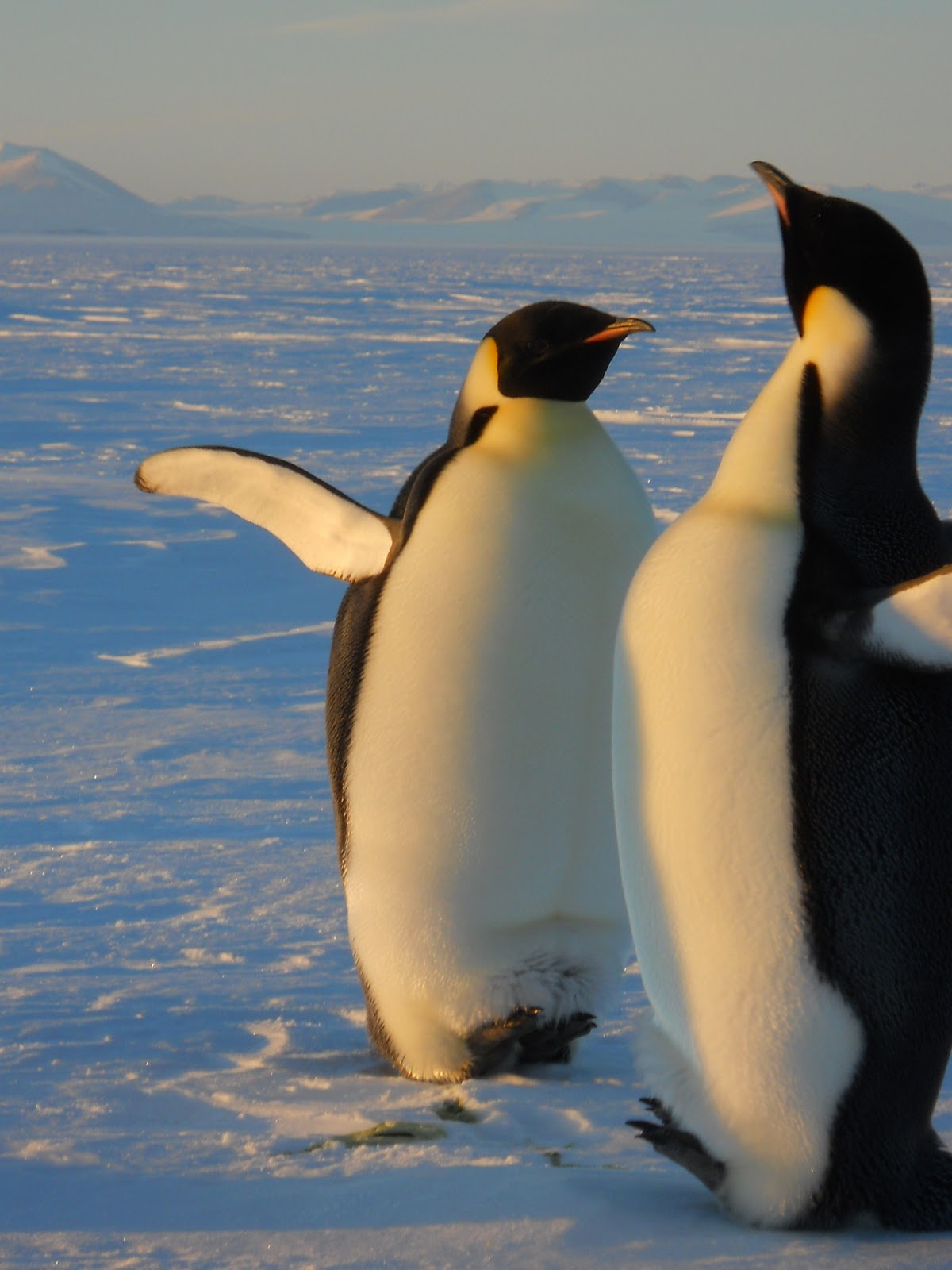
3 February--Penguins Most Artful

I volunteered again this morning to run a tour out to the group of 14 molting Emperor penguins near Half Way House on the road to Pegasus.  These follow a very long 12-hour shift but it's really gratifying to see how much the people enjoy them.  Some people are desk-bound in McMurdo and seldom get out, leading to the question: why bother coming down here?  Economic necessity?  Wanted by the law?  Perversity?  It was very, very cold out there and some people retreated early to the heated van.  It's not entirely unselfish on my part; I thoroughly enjoy being out there.  it's one of the major reasons i came down here.


Advanced molting.  It looked like you could have grabbed fistfuls of feathers.  One website said it took an average of 34 days for an Emperor to molt.


Penguins seem to really fascinate people.  Kneeling, laying down or otherwise getting low seem to set them more at ease.


There are some very talented people down here and it shows in their art: several outdoor metal sculptures; paintings and ceramics displayed in the library; crafts displayed and for sale.  Penguins and other birds are a common theme, perhaps because there is so little life on or above the ice.  (Below the sea ice and the ice shelf life, it's entirely different.  The Ross Sea is wonderfully rich; the algae and bacteria support an unimaginable richness of krill that feed fish, seals, whales, and other life.)


This is titled "Skua Wants A Cracker."


"Snow Petrel"


Walking house of Baba Yaga, Russian witch of fairy tales.


One year's worth of food waste for retrograde to Port Hueneme and composting.  For scale, each of these Tri-Walls is about one meter on a side.  Any food that leaves the kitchen to go to the serving line and is not eaten must be discarded.  Leftovers can only be made from food that stayed in the kitchen


Monday, January 31, 2011

30 January--Castle Rock

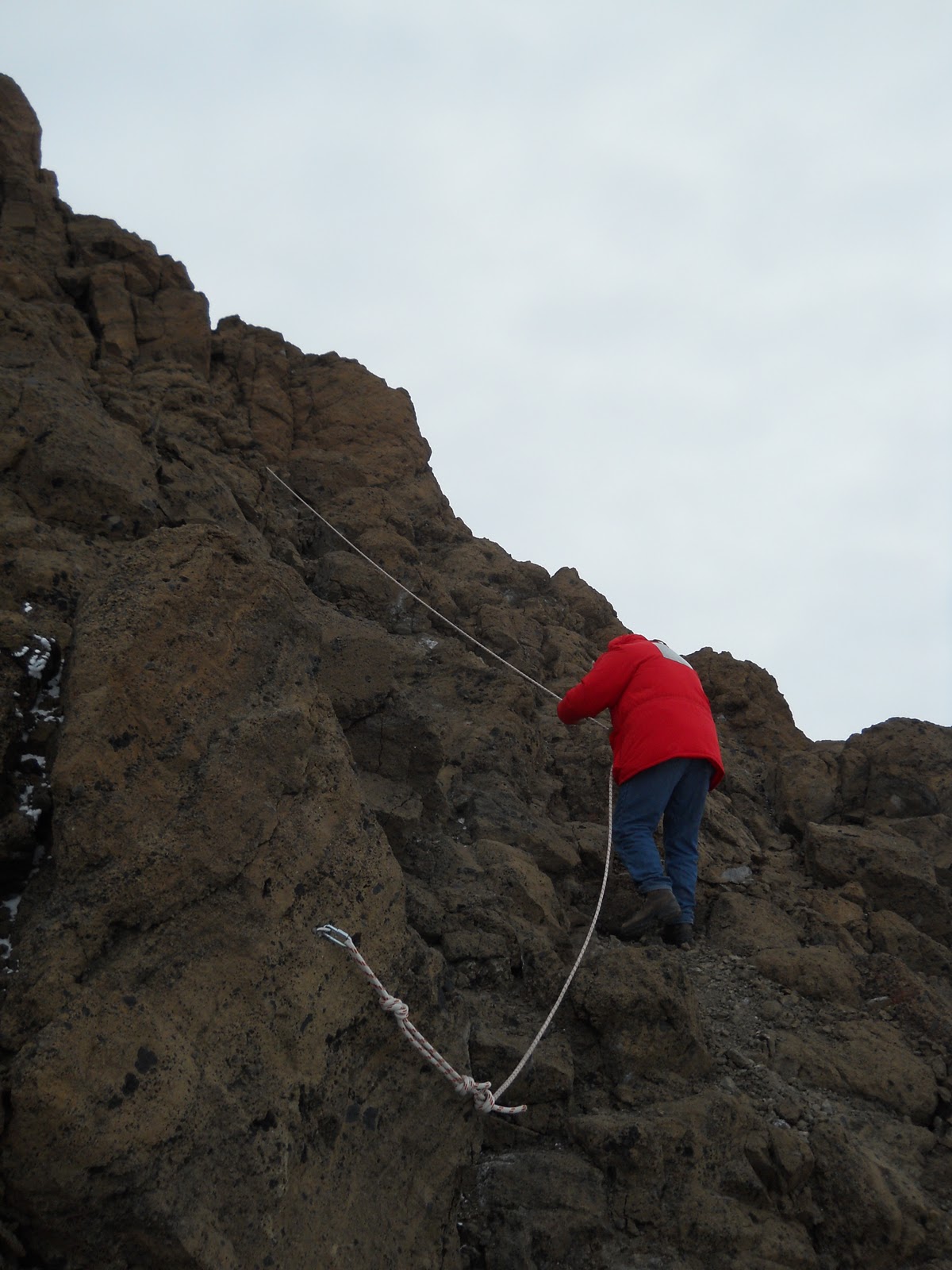
This was the second of my 2 consecutive days off and a welcome break it was.  I finally hiked the Castle Rock Trail and ascended Castle Rock itself.  Jerry Perkins and I left soon after dinner and were back by Mid-Rats.  To hike outside of town any distance, you have to file a plan with the Fire House, have at least 2 people and a radio, have attended the Outdoor Safety lecture, and must check in afterwards.  The trail begins outside of town, up by Arrival Heights, and goes for several miles out to Castle Rock.  Most of it is over hard-packed snow and because of visibility issues, there are flags on bamboo wands every 30 feet or so.  For variety, you can link into a trail that goes back via Scott Base.


 Along the way there are two survival huts called Apples, stocked with sleeping bags and pads; a stove, fuel, and pot; and emergency food.  The second one has a telephone back to base.  I called the Shuttles Office to see if it worked, but was thinking how cool it would be to call Flagstaff.


The Castle is an old volcanic neck made up of basalt and a basalt conglomerate from what must have been a later eruption.  There are lots and lots of basalt pieces included in the reddish brown matrix.  In places there are fixed ropes up the steeper sections of the route.


It's been known as Castle Rock since Robert Falcon Scott's first expedition.  Early in that expedition, a party came up into this area and were hit by a blizzard.  The group had done no prior practice or training--that was pretty standard practice for Scott--and were unable to set up their tent.  Some people tried to make their way back to the nearby Discovery Bay and Hut Point.  One man, George Vince, fell off a steep slope, slid into the water, and drowned.  That's the origin of the cross on the low hill above the hut at Hut Point.  Interestingly, another man knew to burrow a bit into a snow bank and let the storm cover him.  He slept out the storm snugly and walked back to Hut Point the next day, none the worse for wear.


Ice crystals growing inside my water bottle.

The open water meets the sea ice.  A few icebergs, calved off from the Erebus Glacier were visible.


Glaciers flowing out of the Royal Society Range across McMurdo Sound


A Skua doing what it does best.

Tri-walls of food waste awaiting retrograde to Port Heuneme for composting.  MREs for Skuas.  Each is about 1 cubic meter.  (Tri-walls are triple thickness cardboard boxes--just the thing for home storage.)